

Species guideThe Wild.pet species guide
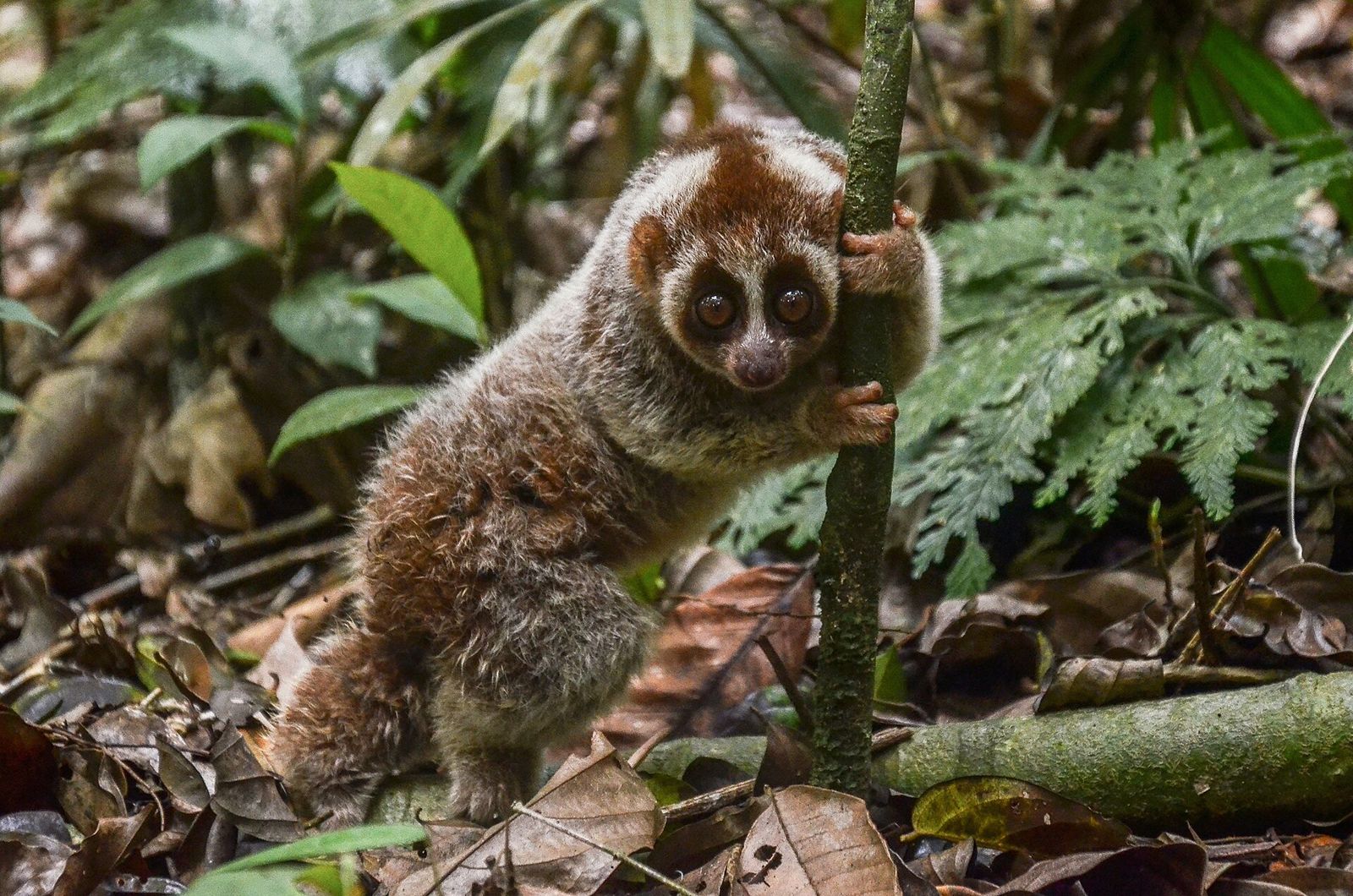 Habitat: Rainforest
Photo: Wahyudhie13, CC BY-SA 4.0, via Wikimedia Commons (resized)
Mammal
Sunda slow loris
IUCN Red List: EndangeredNycticebus coucang
Slow. Shy. Venomous.
A small, big-eyed primate from Southeast Asian rainforests; slow lorises are the only venomous primates.
Care & welfare
Specialist care, not domestication.
Space & enrichment
Shy, nocturnal and easily stressed. Being handled and kept in bright light causes suffering.
Diet & veterinary care
Eats tree gum, nectar, fruit and insects in the wild. Pet diets usually make them sick.
A long-term responsibility
Sunda slow lorises can live 20 years or more in captivity, and the record for slow lorises is just over 25. The pet trade is one of the biggest threats to them, so never buy one or share videos of pet lorises.
Know your state’s rules
Sunda slow loris · Private pet ownership · 5 states researched
- CaliforniaIllegalpi.cdfa.ca.gov · Cal. Code Regs. tit. 14, §§ 671(c), 671.1 (official source for California)
- IllinoisIllegalilga.gov · 720 ILCS 5/48-10 (formerly 720 ILCS 585, as amended by P.A. 96-1219) (official source for Illinois)
- MaineRestrictedmaine.gov · 09-137 C.M.R. ch. 7, §§ 7.06(3)(A), 7.18(2)(F) (official source for Maine)
- New YorkIllegalnysenate.gov · N.Y. Envtl. Conserv. Law §§ 11-0103(6)(e), 11-0512 (official source for New York)
- WashingtonIllegalapp.leg.wa.gov · Rev. Code Wash. §§ 16.30.010(2)(a)(iii), 16.30.030 (official source for Washington)
City and county rules may be stricter. Contact your state wildlife agency before acquiring an animal. Never take wildlife from the wild.
Overview, not legal advice · Checked Nov 15, 2026
Pet suitability
Not a petWhy it's not a pet
- Endangered, with no legitimate way to keep one privately
An endangered primate protected from commercial international trade (CITES Appendix I). The pet trade drives its decline.
Overall difficulty: 4.3 out of 5 (higher is harder). How we rate
- Care difficulty5 out of 5
- Specialist knowledge; mistakes are serious
- Daily time and attention5 out of 5
- Hours every day; constant social needs
- Space3 out of 5
- Moderate
- Environment4 out of 5
- Precise heat, humidity, light or water control
- Diet5 out of 5
- Complex, specialised or hard to source
- Vet care5 out of 5
- Very few specialist vets exist
- Danger4 out of 5
- Can seriously injure people
- Lifespan commitment4 out of 5
- Decades; may outlive its owner
- Yearly cost4 out of 5
- Very high
- Welfare in captivity5 out of 5
- Suffers outside the wild
Compare with another animalBefore you get one
Where it belongs
Scientists sort living things into groups inside groups. Here’s the sunda slow loris’s place, from the biggest group to its own species.
- KingdomAnimalia · animals
- PhylumChordata · animals with a backbone or a rod like one
- ClassMammalia · mammals
- OrderPrimates · primates
- FamilyLorisidae · lorises and pottos
- GenusNycticebus · slow lorises
- SpeciesNycticebus coucang · Sunda slow loris
Checked Nov 15, 2026 against ITIS report: Nycticebus coucang (TSN 572890) and Animal Diversity Web: Nycticebus coucang.
Quick facts
- Type
- Mammal
- Lifespan
- 20 years or more in care
Fun fact: A slow loris makes venom by mixing a secretion from a gland inside its elbow with its saliva.
Where it lives in the wild
- Asia (Southeast Asia)
Habitat: Rainforest
Conservation
IUCN Red List: Endangered. This species is threatened with extinction in the wild. International trade: CITES Appendix I: commercial international trade is banned.
Threatened by habitat loss and the illegal pet trade. Slow lorises sold as pets often have their teeth cut or pulled out, and many die from stress and poor diet.
Before you get one
Not a pet: a sunda slow loris should never be kept as one.
- Endangered, with no legitimate way to keep one privately
An endangered primate protected from commercial international trade (CITES Appendix I). The pet trade drives its decline.
Here is what it would need, so you can see why.
Space
3 out of 51 is a tank or small enclosure; 5 is acres of land.
Read about space and enrichmentDiet
5 out of 51 is simple, easy to buy; 5 is complex, specialised or hard to source.
Read about diet and veterinary careVet care
5 out of 51 is most vets can help; 5 is very few specialist vets exist.
Read about diet and veterinary careDaily time and attention
5 out of 51 is a few minutes a day; 5 is hours every day; constant social needs.
See the pet suitability scoresLifespan commitment
4 out of 51 is a few years; 5 is decades; may outlive its owner.
20 years or more in care
See the quick factsIs it legal where you live?
Pick your state in “Is it legal where I live?” to see the rule that applies there.
Is it legal where I live?
This is general guidance, not legal advice. Laws change, and cities and counties can add their own rules. Before getting any animal, check with your state wildlife agency, and if you're under 18, talk to a grown-up first.
Pick a state to see what applies there. Your choice stays on this device.
Rules that apply in every state
- RestrictedEverywhere· Buying, selling or moving one
All slow lorises are on CITES Appendix I, which bans international trade for commercial purposes. Pet-trade lorises crossing borders are being trafficked.
CITES Appendix I (genus Nycticebus); 50 CFR part 23 · CITES Appendices I, II and III · also Three new slow loris species discovered in Borneo (Scientific American) · checked 2026-11-15
- RestrictedUnited States (federal)· Bringing one into the country · applies to all primates
Since 1975, live primates may only be imported by CDC-registered importers for science, education or exhibition. Keeping one as a pet is not a permitted use.
42 CFR 71.53 · 42 CFR § 71.53, Requirements for importers of nonhuman primates · also Bringing a nonhuman primate into the US (CDC) · checked 2026-11-15
State rules
Researched so far in 5 of the 50 states and DC. Everywhere else shows “not yet researched”: that never means legal.
- IllegalCalifornia· Keeping one · applies to all primates
California lists every primate species except humans as a restricted animal. Restricted animals can only be kept with a state permit, and permits aren't issued for pets.
Cal. Code Regs. tit. 14, §§ 671(c), 671.1 · 14 CCR 671 restricted wild animal list (California Department of Food and Agriculture copy) · also Cal. Code Regs. tit. 14, § 671 (Cornell Legal Information Institute) · checked 2026-11-15
- IllegalIllinois· Keeping one · applies to all primates
Illinois makes it a crime to keep a primate (the law names lorises, lemurs, monkeys and apes) except at zoos, licensed exhibits and similar facilities. The primate ban was added in 2010 and moved into the Criminal Code in 2013.
720 ILCS 5/48-10 (formerly 720 ILCS 585, as amended by P.A. 96-1219) · Public Act 96-1219, adding primates to the Dangerous Animals Act (Illinois General Assembly) · also 720 ILCS 5/48-10, Dangerous animals (current text via FindLaw) · checked 2026-11-15
- RestrictedMaine· Keeping one · applies to all primates
Maine lists all primates as Category 1 Restricted Species. Only exhibitors, wildlife rehabilitators, registered labs and accredited research facilities can get a permit for Category 1 animals, so they can't be kept as pets. (A narrow exception for capuchin monkeys trained as physical aides doesn't cover lorises.)
09-137 C.M.R. ch. 7, §§ 7.06(3)(A), 7.18(2)(F) · 09-137 C.M.R. ch. 7, Rules for Importation, Possession, Propagation, Rehabilitation and Exhibition of Wildlife (Maine Secretary of State, official text, amended 2021) · also 09-137 C.M.R. ch. 7, § 18, Species Lists (Cornell Legal Information Institute) · checked 2026-11-15
- IllegalNew York· Keeping one · applies to all primates
New York bans keeping wild animals as pets, and its definition of wild animal includes all nonhuman primates and prosimians (which includes lorises).
N.Y. Envtl. Conserv. Law §§ 11-0103(6)(e), 11-0512 · N.Y. Environmental Conservation Law § 11-0512 · also N.Y. Environmental Conservation Law § 11-0103 text and summary (Animal Legal & Historical Center) · checked 2026-11-15
- IllegalWashington· Keeping one · applies to all primates
Washington lists all nonhuman primates as potentially dangerous wild animals, which people may not own, keep, breed or bring into the state.
Rev. Code Wash. §§ 16.30.010(2)(a)(iii), 16.30.030 · RCW 16.30.010 (dangerous wild animals: definitions) · also Washington dangerous wild animals law, RCW 16.30 (Animal Legal & Historical Center) · checked 2026-11-15
Protect the habitat. Respect the sunda slow loris.
Keep a respectful distance. Never feed wildlife. Support local habitat restoration.
Check ownership lawsAnimals that share its home

Sources
- NParks Singapore: Nycticebus coucang (accessed 2026-11-15)
- Wikipedia: Sunda slow loris (accessed 2026-11-15)
- Plazi: Nycticebus coucang (Handbook of the Mammals of the World) (accessed 2026-11-15)
- Primate Info Net (Wisconsin National Primate Research Center): Slow loris (accessed 2026-11-15)
Pet suitability scores are Wild.pet's own judgments. See how we rate.